

Best Electric Lighters for Candles: 2026 Guide
Table of Contents
- What to Look for in the Best Electric Lighters for Candles
- Plasma Lighter vs Butane Lighter: Which Wins for Candles?
- Best Flameless Lighter for Deep Jar Candles
- How to Clean Electric Lighter Arc Components
- Battery Life, Charging Safety, and Electrode Durability
- Use-Case Limits: When an Electric Lighter Falls Short
- Frequently Asked Questions
Last Updated: September 29, 2026
What to Look for in the Best Electric Lighters for Candles
The best electric lighters for candles share three traits: a long or flexible neck that reaches into deep jars, a safety lock that prevents accidental ignition, and a rechargeable battery that holds its charge between uses.
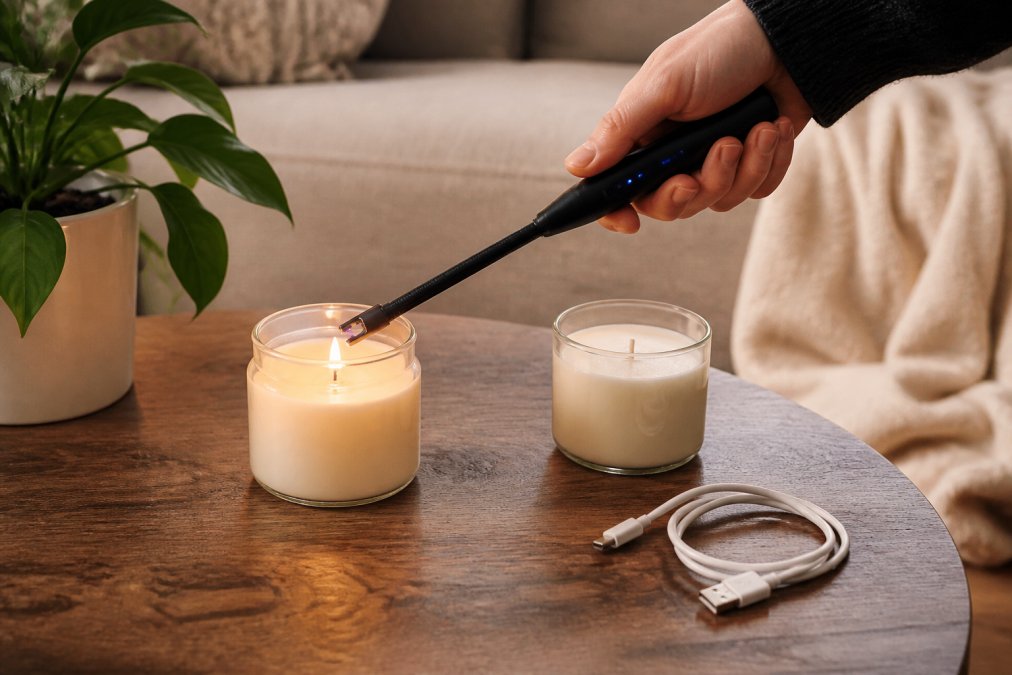
Neck Length and Reach
Wick reach is the make-or-break measurement. A standard disposable lighter has a fixed flame about 2.5 centimeters above the tip, fine for a tea light, useless for a 15-centimeter jar.
Battery, Safety Lock, and Arc Type
Battery capacity and arc configuration decide how often you recharge and how fast a wick lights. Most rechargeable models use a lithium-ion battery charged over USB-C, with a full cycle taking 1 to 2 hours.
Arc type matters too:
- Single arc: one gap, gentler ignition, better for soft wicks
- Dual arc: two gaps, wider ignition zone, faster lighting on stubborn wicks
- Triple arc: widest zone, best for thick or multi-wick candles, drains faster
Plasma Lighter vs Butane Lighter: Which Wins for Candles?
For candle lighting, a plasma lighter wins on windproof performance, refill cost, and safety. A butane lighter wins on price and on one task: lighting a wick at an awkward angle inside a narrow jar.
Here is the honest comparison:
| Factor | Plasma Arc Lighter | Butane Lighter |
|---|---|---|
| Fuel | Rechargeable battery | Butane canister |
| Wind resistance | High, flame-free | Low to moderate |
| Refill cost | None | Ongoing canister purchases |
| Wick reach | 7-12 cm on long-neck models | Fixed, usually short |
| Cold weather | Reliable | Flame struggles below freezing |
| Upfront cost | Higher | Lower |
Windproof Performance and Flame-Free Ignition
Windproof performance is where the gap is widest. A butane flame bends, sputters, and dies in a breeze. A plasma arc does not care about moving air because there is no flame to blow out.
Best Flameless Lighter for Deep Jar Candles
The best flameless lighter for deep jar candles is a flexible-neck plasma arc model with a dual arc: the bendable neck reaches past the rim and the dual gap lights the wick on the first press. Rigid long-neck models work only if the jar opening admits the whole barrel.
Three features decide the winner for deep jars:
- Flexible neck: bends to follow the jar's interior wall
- Dual or triple arc: covers a wider wick area in one press
- Ergonomic design: a textured grip keeps your hand steady when you are reaching down
How to Clean Electric Lighter Arc Components
- Let the lighter cool for at least two minutes after use
- Slide the safety lock to the off position
- Inspect the electrodes for black carbon buildup or wick debris
- Brush the electrode tips with a dry, soft-bristle brush
- Wipe the ceramic insulator with a dry cotton swab
- Never use water, alcohol, or metal tools on the arc assembly
- Press the ignition once to confirm a clean, even arc
Carbon buildup comes from wick smoke and wax vapor condensing on the electrodes. It is normal, not a defect, and the single biggest reason a working lighter starts feeling unreliable.
Battery Life, Charging Safety, and Electrode Durability
Battery life on a rechargeable arc lighter typically covers several weeks of normal candle use per charge, though heavy daily use shortens that considerably. Charging safety and electrode durability are the two areas most roundups skip, and where long-term owners run into trouble.
What Actually Happens Inside the Battery
Nearly every rechargeable arc lighter runs on a single lithium-ion cell, usually an 18650 or a slim pouch cell rated between 500 and 1,500 mAh. Small batteries are sensitive to how they are treated.
- Deep discharge: running the cell to zero before recharging stresses the anode. Charge when the LED indicator drops to one bar, not when the lighter stops firing.
- Heat during charging: a cell charged above roughly 113°F (45°C) ages faster. A hot windowsill, a parked car, or a charging pad next to a radiator all count.
- Overvoltage from mismatched chargers: this is the one most owners never hear about.
The Fast-Charger Problem
USB-C fast charging is convenient, but a plasma lighter is not a phone. Most arc lighters draw only a fraction of what a 30W or 65W wall adapter can deliver, and the internal charge controller limits the current. On a well-built unit, that controller handles the negotiation correctly.
- Overcharge protection, cuts input once the cell hits full voltage
- Over-discharge protection, prevents the cell from draining past its safe floor
- Short-circuit protection, isolates the cell if the arc assembly faults
- Temperature cutoff, pauses charging if the cell gets too warm
Electrode Durability: The Quiet Long-Term Cost
Arc electrodes degrade with every ignition. The tips pit and erode over hundreds of cycles, and the gap widens slightly as material is lost. Cleaning slows this; nothing stops it.
What you can control:
- Cleaning cadence: every 10 to 15 ignitions keeps carbon from insulating the tips and forcing the arc to work harder
- Cool-down between candles: a lighter used for twenty consecutive ignitions gets hot at the tip, and heat accelerates electrode wear, give it a minute between candles
- Ignition duration: hold the button only as long as the wick needs. A two-second press lights most wicks; a ten-second press just burns the electrode
Use-Case Limits: When an Electric Lighter Falls Short
An electric lighter is the wrong tool in a few specific situations, and knowing them saves a frustrating purchase. Flame-free ignition is excellent for candles, grills, and camping, but not universal. The limits below are the ones that actually come up for candle owners.
Wick and Wax Problems
An arc lighter ignites by passing current through a conductive path. A dry, upright cotton wick is ideal. Several common candle conditions are not:
- Wicks drowned in a deep wax pool: if the wick tip is submerged in liquid wax, the arc has nothing to grab. Blot the pool with a paper towel or let the candle cool and trim the wick before relighting.
- Wood wicks: these can light, but they need more contact time than a cotton wick. A dual or triple arc helps because the wider ignition zone covers more of the wood surface. A single arc often just scorches the edge.
- Very short or mushroomed wicks: trim to about 1/4 inch first. A wick shorter than that sits too close to the wax surface for the arc to catch cleanly.
- Wicks with heavy fragrance oil residue: some highly scented candles leave a gummy film on the wick that resists ignition. Scrape it gently with a fingernail before lighting.
Jar Geometry Limits
Neck length solves most reach problems, but not all of them. Two geometries still defeat an arc lighter:
- Narrow-mouth jars: if the opening is under roughly 1 inch across, the barrel will not fit, flexible neck or not. A long wooden match is the practical fallback.
- Wide, shallow bowls with a deep rim: a rigid barrel forces your wrist into an awkward angle and puts the arc closer to your fingers than is comfortable. A flexible neck removes this, which is why it is the better choice for three-wick bowls.
Cold Weather and Battery Behavior
Lithium-ion cells lose usable capacity as temperatures drop (pubmed.ncbi.nlm.nih.gov). A plasma lighter that works perfectly in a warm kitchen may need warming in a pocket before it fires reliably on a winter hike. This is battery chemistry, not a defect, and the most common complaint from campers expecting all-weather performance.
What an Arc Lighter Cannot Do
- Light a cigar: a cigar needs a sustained, even flame or a broad ember. An arc scorches the wrapper without an even light.
- Provide a continuous flame: an arc ignites, it does not burn. Anything requiring a steady flame, soldering, melting wax, starting a charcoal chimney, needs a different tool.
- Work as a survival fire starter in wet conditions: the arc will not dry out tinder. It lights what is already dry and reachable.
For candle owners specifically, none of these limits usually apply. Jar candles sit indoors, at room temperature, with openings wide enough for a long-neck or flexible model, the use case where a rechargeable arc lighter is close to ideal.
Frequently Asked Questions
Do electric lighters work on candles?
Yes. A plasma arc lighter produces a small electrical arc that ignites a candle wick without a flame. Long-neck and flexible-neck models reach wicks inside deep jars where a standard flame lighter struggles. The arc needs direct contact with the wick, so position the prongs around the wick and hold for one to two seconds. Carbon buildup on the wick can slow ignition, so trim it when needed.
Are electric lighters safer than traditional butane lighters?
Electric lighters remove an open flame and the need to store butane fuel. Most models include a safety lock or child-resistant switch and an LED indicator, and they cool down quickly after use. Butane lighters carry fuel that can leak and a flame that stays lit until you release it. For candle use, the flame-free design of a flameless lighter reduces the risk of tipping or dripping wax onto a flame.
How long does an electric lighter charge last?
Most rechargeable electric lighters run on a lithium-ion battery charged through USB-C. A full charge typically covers dozens to well over a hundred ignitions depending on arc intensity and how long you hold the button. Charging time commonly falls between one and two hours. Battery capacity varies by model, so check the listed specifications before buying.
What are the downsides of using an electric lighter?
Electric lighters have real limits. The arc needs to touch the wick, so a wick buried deep in a wide jar can be hard to reach even with a long neck. Electrodes wear down over time and carbon buildup reduces arc intensity, requiring regular cleaning. Cold weather can shorten battery capacity. They also will not light a wick that is soaked in wax or already trimmed too short.
Candle owners who are tired of dead butane lighters, singed fingers, and drawers full of spent disposables have a better option now. Lighter Deals USA stocks a curated range of electric and USB-rechargeable lighters built for reach, safety, and everyday reliability, all shipped fast from domestic inventory through a secure, encrypted checkout. Browse the collection and pick the neck length and arc type that fits your candles.
