

Is a Durable Electric Lighter for Everyday Use Worth It?
Last Updated: October 25, 2026
Quick Summary
A durable electric lighter for everyday use is worth it because build quality decides lifespan far more than arc count or marketing claims. Focus your money on a metal case, a firm hinge, a recessed ignition button, and USB-C charging, since those parts fail before the arc or battery.
- Press the ignition button ten times in a row and count the failures; a quality unit fires every time.
- Ignore arc count as a headline feature, since triple arc drains the battery faster and adds little for everyday tasks.
- Charge the lighter on the same day each week and keep a short USB-C cable in your bag.
- Clean a plasma lighter by letting it cool, brushing the electrode tips, and wiping the housing with a dry cloth.
- Most electric lighters fail at the hinge, button, and charging port before the arc or battery.
Table of Contents
- What Makes a Durable Electric Lighter for Everyday Use
- The Best Electric Lighter for Everyday Use: Buying Criteria That Matter
- Electric Lighter vs Butane: Which Holds Up Better Day to Day
- Electric Lighter Battery Life: Charge Cycles, Indicators, and Real Limits
- How to Clean a Plasma Lighter Without Damaging the Arc
- Durability, Safety, and Everyday Carry: What Fails First
- Choosing Your Durable Electric Lighter at Lighter Deals USA
- Frequently Asked Questions
What Makes a Durable Electric Lighter for Everyday Use
A durable electric lighter for everyday use is one built to survive pocket carry, repeated ignition, and the small abuses that kill cheap models in weeks. Build quality decides lifespan far more than arc count or marketing claims.
The core failure points are few. A weak hinge, a plastic ignition button that softens with heat, or a battery that loses capacity after a few dozen charges will end a lighter's life long before the arc itself wears out.
Arc Type, Build Materials, and Ignition Controls
Electric arc ignition is the flameless, windproof system that uses two or more electrodes to create a small plasma arc. Single arc models handle candles and cigarettes. Dual and triple arc setups spread the heat across a wider area, which helps with thick candle wicks and grill lighting.
Materials matter more than arc count. A metal case resists cracking when dropped, and a recessed ignition button prevents accidental activation in a pocket.
The Best Electric Lighter for Everyday Use: Buying Criteria That Matter
The best electric lighter for everyday use balances ignition reliability, battery life, and construction, in that order. Ignition reliability comes first because a lighter that fails in wind is useless regardless of how it looks.
Here is how to score a candidate before buying:
| Criterion | What to Check | Why It Matters |
|---|---|---|
| Ignition consistency | 10 consecutive presses, indoors and in wind | Reveals weak arc or bad contacts |
| Battery and charging | USB-C charging, charge time, indicator lights | Prevents mid-use failures |
| Build materials | Metal case, hinge stiffness, button feel | Predicts drop and pocket survival |
| Safety controls | Safety lock, recessed ignition button | Prevents accidental activation |
| Ergonomics | Weight, grip, flexible neck | Determines daily comfort |
A practical test: press the ignition button ten times in a row and count the failures. A quality unit fires every time. If you want a structured method, our guide on how to test lighter ignition reliability walks through the check step by step.
What to Ignore in Product Listings
Ignore arc count as a headline feature. Triple arc sounds impressive but drains the battery faster and adds little for everyday tasks. Skip listings that lead with flame size language, since electric lighters produce no flame at all.
Be skeptical of "windproof" claims with no detail. Every arc lighter is windproof by design because there is no flame to blow out, so the word tells you nothing about build quality.
Electric Lighter vs Butane: Which Holds Up Better Day to Day
Electric lighters win on day-to-day reliability for most people. There is no fuel to refill, no flame to blow out, and no fluid smell in your pocket.
The trade-off is charging. An electric lighter needs a USB rechargeable battery and a habit of topping it up. Butane needs refilling and can leak or dry out over time. For a fuller side-by-side, see our breakdown of butane lighters versus electric lighters.
Electric Lighter Battery Life: Charge Cycles, Indicators, and Real Limits
Battery life is where marketing claims and real-world performance diverge most. A consistent test method tells you more than any spec sheet.
Compare usable ignitions per charge, not case size
Battery life depends on arc type and use frequency, not on how large the case is. A single-arc model on short daily use will typically deliver more ignitions per charge than a triple-arc unit used the same way, because each ignition draws less power. When comparing models, ask how many ignitions a full charge delivers under normal use, a short press of a second or two, not a long hold.
A simple, repeatable test
You can measure this yourself without special equipment:
- Charge the lighter fully and note the charging time.
- Fire ten short ignitions, then rest the unit briefly so the electrodes cool.
- Repeat in blocks of ten until the arc weakens or the unit refuses to fire.
- Record the total ignitions and the charging time.
Run the same test on each candidate and you have a fair comparison. The last portion of a charge can take longest, so treat the stated charging time as a minimum.
Standby drain and charge-cycle degradation
A lighter left unused still loses charge slowly. Standby drain is usually modest, but a unit stored for weeks may need a top-up before first use. Lithium cells also lose capacity over many charge cycles, and heat and cold accelerate that loss. Cold storage, a cold vehicle in winter, for example, is a common cause of premature degradation. Keep the lighter at room temperature when you can.
What shortens battery life in practice
- Long presses. Holding the ignition button after the arc lights wastes charge and heats the electrodes.
- Frequent triple-arc use. More arcs mean more draw per ignition.
- Cheap charging ports. Micro-USB ports wear out; USB-C charging is the more durable standard.
Reading the battery indicator
A battery indicator is not a luxury. It tells you when remaining charge is low so you can recharge before you are caught without ignition. Indicators vary, some show discrete levels, others a single low-charge light, so learn what yours signals before you rely on it. Pair the indicator with a habit: top up on a fixed day each week rather than waiting for the arc to weaken.
How to Clean a Plasma Lighter Without Damaging the Arc
Clean a plasma lighter by letting it cool completely, then brushing the electrode tips with a soft brush and wiping the housing with a dry cloth.
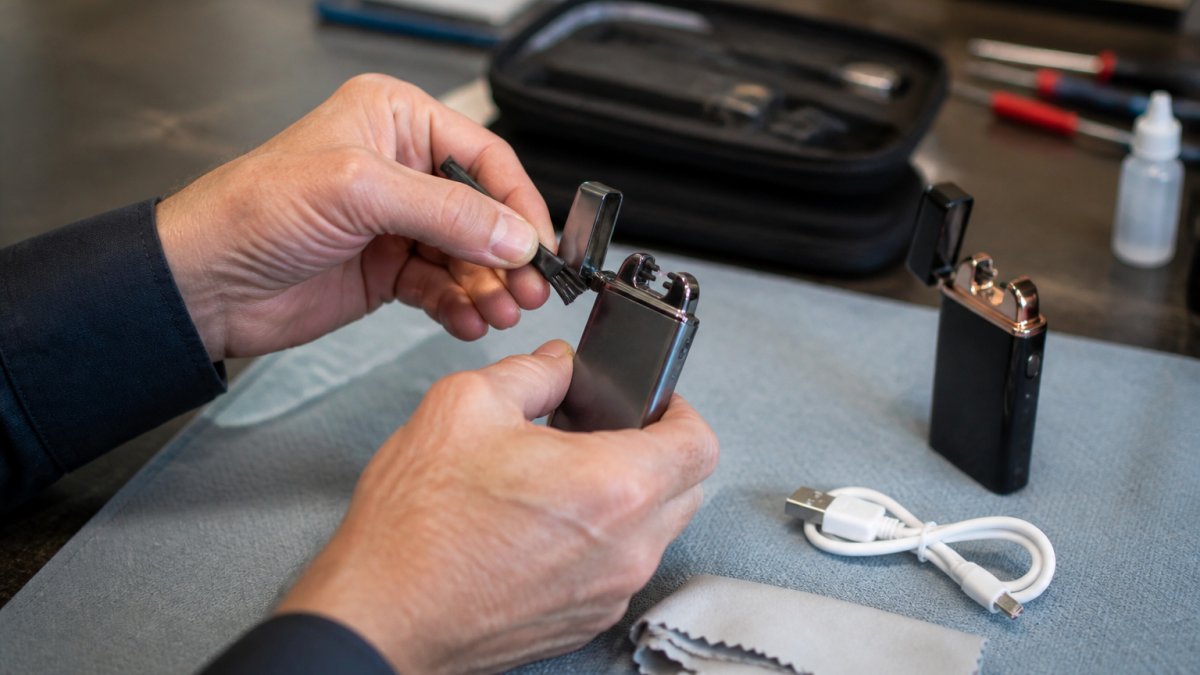
Soot and lint build up on the electrodes and cause weak or inconsistent ignition. A dry soft brush clears most of it. For the full routine, our guide on how to clean a plasma lighter covers each step.
Durability, Safety, and Everyday Carry: What Fails First
Most electric lighters do not die from a worn-out arc. They die from the parts around it. Understanding the common failure sequence lets you judge a model before you buy and get more months out of the one you own.
The failure sequence, in order
A common pattern across everyday-carry users is a predictable order of wear:
- Hinge loosening. Repeated opening and closing works the hinge pin and the plastic or metal boss around it. A lid that starts to wobble is the first sign.
- Ignition button wear. The button takes heat and pressure at the same contact point on every press. Soft or thin buttons develop a mushy feel and eventually fail to close the circuit reliably.
- Charging-port wear. Micro-USB ports are the most fragile connector still common on lighters; the internal pins bend and the port loosens. USB-C is the more durable standard and worth prioritizing.
- Electrode fouling or bending. Soot, lint, and bent prongs change the arc gap and cause weak or inconsistent ignition, usually fixable with cleaning rather than replacement.
- Battery capacity loss. Lithium cells degrade gradually, especially with heat and cold storage. This is usually the last thing to fail, not the first.
What to inspect before you commit
- Hinge: open and close the lid ten times. It should feel firm with no side-to-side play.
- Button: press it ten times. Every press should fire. A button that needs a second try is already worn.
- Case material: a metal case resists cracking on drops; thin plastic flexes and eventually splits at the hinge boss.
Repairability, warranty, and end-of-life
Electric lighters are largely sealed units, so plan for replacement rather than repair. Before buying, check three things: the stated warranty period, whether the seller honors it on battery and button failures (not just dead-on-arrival), and whether replacement parts such as a charging cable or cover are available. At end of life, dispose of the lithium cell responsibly rather than tossing the whole unit in household trash (the EPA).
Everyday carry safety
A lighter that fires in a pocket or bag is a genuine hazard. A safety lock or a recessed ignition button that requires deliberate pressure prevents accidental activation. Check the switch action before you carry a model loose in a pocket, and prefer a lock that cannot be nudged open by keys or a phone. Check the TSA rules on lighters and e-cigarettes before you pack, and read our guide on whether electric lighters are safe for travel for the current flight rules.
Choosing Your Durable Electric Lighter at Lighter Deals USA
Choosing well comes down to three decisions: arc type for your main task, a metal case for pocket survival, and a battery indicator so you are never caught without charge. Get those right and the lighter will outlast several cheap replacements.
We stock electric lighters built for daily carry, and every order ships from within the country with secure, encrypted checkout. Customers like Daniel K. put it simply: "Great quality and detailed appearance and finish… Perfect condition." If you are ready to pick, browse our everyday carry lighter options.
Frequently Asked Questions
What makes an electric lighter durable enough for everyday use?
The deciding factors are the arc assembly, the ignition button, and the case. Metal-bodied lighters with reinforced arc prongs and a recessed ignition button survive pocket carry far better than plastic shells. A safety lock that prevents accidental firing also extends life, because it keeps the arc from running while the lighter sits in a bag. Look for a battery indicator so you are not deep-discharging the cell, and check whether replacement parts or a warranty are offered before you buy.
How long does a durable electric lighter battery last before it needs replacing?
Most rechargeable electric lighters use a lithium-based cell rated for several hundred charge cycles, though exact figures vary by model and are rarely published. In practice, daily users typically recharge every one to three weeks depending on how often they light up. Battery life shortens if you store the lighter fully drained or leave it in a hot car. Recharging at around 20 percent remaining, rather than waiting for a full shutdown, is the simplest habit that extends cell life.
Are plasma lighters windproof enough for camping and outdoor use?
Yes. A plasma lighter creates a flame-free electric arc, so wind does not blow it out the way it does a butane flame. That makes it reliable for lighting a candle wick, a stove, or tinder in breezy conditions. The limits are different from wind: the arc is short, so it works best on exposed wicks and small tinder rather than deep candle jars, and extreme cold reduces battery output. For campers, a flexible neck model reaches into tight spots more easily.
Is an electric lighter better than a butane lighter for everyday use?
It depends on what you light. Electric lighters win on wind resistance, no fuel refills, and no flame to relight. Butane jet torches win on heat output for grills, cigars, and thick wicks, and they do not depend on a charged battery. For everyday carry, pocket use, and candle lighting, an electric lighter is usually the lower-maintenance choice. For BBQ and outdoor cooking, a butane torch still has the edge. Many households keep one of each for that reason.
A lighter that dies in a month costs more than one that lasts for years. We built Lighter Deals USA around carefully selected, high-quality lighters, fast and reliable nationwide shipping, and a checkout you can trust. Get started with Lighter Deals USA and carry a lighter that works every time you reach for it.

