

Electric vs Butane Lighter Performance: 2026 Guide
Table of Contents
- Electric vs Butane Lighter Performance: How the Two Ignition Types Compare
- Performance Comparison Table: Electric vs Butane at a Glance
- Electric Lighter vs Butane Reliability: Ignition Consistency Across Conditions
- Electric Lighter Wind Resistance: How Arc and Flame Designs Handle Drafts
- Electric Lighter Battery Life and Butane Fuel Capacity in Real Use
- Humidity, Wet Conditions, and Cold-Weather Performance
- Best Lighter for Camping and Outdoor Ignition Tasks
- Safety, Transport, and Disposal for Both Lighter Types
- Which Should You Choose?
- Frequently Asked Questions
Last Updated: October 5, 2026
Electric vs Butane Lighter Performance: How the Two Ignition Types Compare
Electric vs butane lighter performance comes down to one trade-off: butane gives you raw heat and unlimited refills, while electric gives you wind resistance and no fuel to run out of. An electric lighter uses a rechargeable battery to create a plasma arc between two electrodes, so there is no flame. A butane lighter burns pressurized fuel to produce an adjustable, aimable flame.
At Lighter Deals USA, we stock both styles, and neither wins everywhere. The conditions you light in decide the winner.
Here is the short version before the details:
- Electric arc lighters win in wind, in the cold, and for anyone tired of buying fuel.
- Butane jet torch lighters win for sustained heat, adjustable flame, and tasks like soldering or lighting a fire in wet weather.
- Both fail if you ignore the maintenance each type needs.
Below, we break down reliability, wind resistance, capacity, and safety so you can pick with confidence.

Performance Comparison Table: Electric vs Butane at a Glance
| Factor | Electric Arc Lighter | Butane Jet Torch Lighter |
|---|---|---|
| Ignition source | Plasma arc between electrodes | Flame from pressurized butane |
| Wind resistance | Excellent, arc is not affected by drafts | Good to excellent with a jet torch design |
| Cold weather | Battery output drops in deep cold | Fuel pressure drops in deep cold |
| Wet conditions | Works when wet, arcs dry out | Flame struggles if the nozzle is soaked |
| Refueling | USB-C recharge | Butane refill canister |
| Heat type | Concentrated but brief | Sustained, adjustable flame |
| Best for | Everyday carry, camping backup, gifts | Fire starting, plumbing, sustained heat tasks |
| Running cost | Electricity only | Ongoing butane purchases |
Electric Lighter vs Butane Reliability: Ignition Consistency Across Conditions
Butane jet torch lighters are more reliable for sustained ignition, while electric arc lighters are more reliable for consistent first-strike ignition.
A butane jet torch lighter fires every time as long as fuel is present and the nozzle is clear. Its weakness is the fuel itself. Cold shrinks the gas, low fuel means a weak flame, and a clogged nozzle stops ignition entirely.
An electric lighter has far fewer moving parts: press the button, the arc jumps, and it lights. The failure point is usually the battery, not the mechanism. A charged arc lighter with clean electrodes almost always fires.
Reliability is really about the failure mode you can live with. Running out of butane mid-trip is common; a dead battery is just as annoying. Carry a backup of whichever type you choose.
Electric Lighter Wind Resistance: How Arc and Flame Designs Handle Drafts
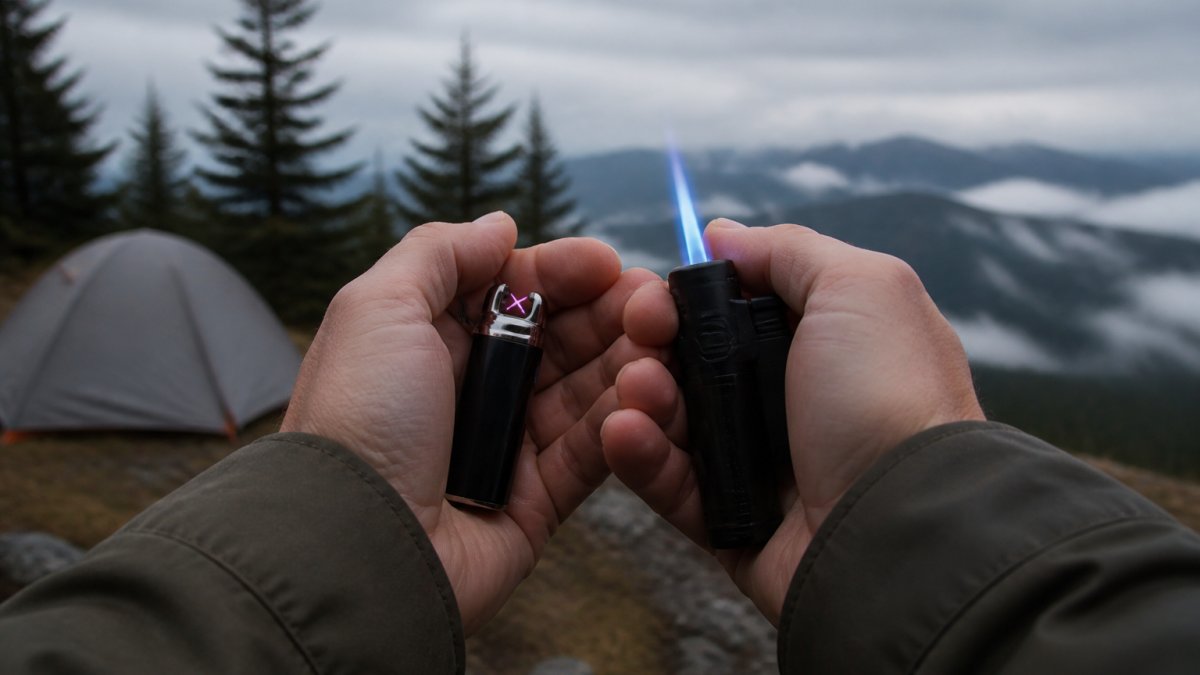
Electric arc lighters handle wind better than any open-flame lighter because there is no flame to blow out.
Butane jet torch lighters close most of that gap. A jet torch forces fuel through a narrow nozzle at high pressure, producing a concentrated flame that resists drafts far better than a soft-flame lighter.
A common mistake is buying a "windproof" label without checking the design. Soft-flame butane lighters are not windproof at all. Jet torch and arc models are the two designs that actually hold up.
For a windy ridge line, the arc lighter is the safer bet. For controlled, sustained heat in moderate wind, a jet torch is the better tool.
Electric Lighter Battery Life and Butane Fuel Capacity in Real Use
The useful comparison is capacity in real use: how many ignitions you get, how long a top-up takes, and how performance declines as the battery or tank empties.
Electric arc lighters: ignitions per charge
Arc lighters are rated in ignitions, not hours, because each press draws a short, high-current pulse.
Recharge time is the other half of the equation. A USB-C arc lighter on a standard 5V/1A charger refills in about 1-2 hours; some models cut that to under an hour.
Battery decline is gradual. Lithium-ion cells lose capacity over hundreds of charge cycles and perform worse in the cold.
Butane lighters: lights per refill
Butane capacity is measured by fuel volume, and the flame design sets the burn rate. A quad-jet torch burns about four times the fuel per second, so the same tank empties far faster.

Refilling is fast with a canister on hand: purging and refilling a pocket torch takes a minute or two.
Running cost over a year
Assume daily carry with about five ignitions a day, roughly 1,800 a year:
- An arc lighter covers that on a handful of charges. Electricity cost is negligible, and the main long-term expense is eventual battery replacement or a new unit.
- A single-jet butane torch at roughly 150 ignitions per fill needs about a dozen refills a year. A multi-pack of butane canisters is inexpensive, but the cost recurs every year and never stops.
For light, occasional use, the arc lighter is cheaper to run. For heavy, sustained use, butane refills are cheap per ignition and you never wait on a charger.
Humidity, Wet Conditions, and Cold-Weather Performance
Cold weather hurts both types differently. Butane pressure drops as temperatures fall, so a torch that roars at room temperature may barely light below freezing.
Humidity and moisture are where the arc lighter pulls ahead. Water does not stop a plasma arc the way it smothers a flame. An arc lighter that gets rained on can often be shaken off and used again.
Durability matters too. A sealed electric lighter with few openings handles moisture better than a fuel lighter with a refill valve and adjustable nozzle. If you regularly light up in wet conditions, that design difference decides which lighter survives the season.
Altitude is the angle most guides skip. At high elevation, butane pressure and oxygen both drop, so flames weaken. Arc lighters are less affected because they do not depend on fuel pressure, giving them a real edge for high-altitude hiking.
Jumbo Chrome Jet Torch Lighter Electronic Ignition Select 4 Colors USA →
Best Lighter for Camping and Outdoor Ignition Tasks
The right lighter depends less on the model than on the task.
An arc lighter is excellent here.
Camp stoves and portable burners
Both types work, but the jet torch has the edge.
Campfires and damp wood
This is where a butane jet torch wins clearly. Starting a fire means sustained heat on tinder and kindling, and an arc lighter only produces a brief spark-like pulse.
Cigars and pipes
Flame type matters more than ignition source here. A soft butane flame is traditional because it lets you toast and rotate the cigar without scorching it.
Soldering, repairs, and heat-shrink
Only a butane jet torch is appropriate. These tasks need a sustained, adjustable, high-temperature flame, and an arc lighter cannot deliver continuous heat to a workpiece.
Everyday carry and gifts
For a pocket lighter you press a few times a day, an arc lighter is convenient: no fuel, no flame, and it survives wind and rain.
The practical takeaway
No single lighter is best at every task.
Safety, Transport, and Disposal for Both Lighter Types
Both lighter types carry real safety considerations, and the rules differ. Butane lighters hold pressurized flammable fuel, so heat and puncture are the main risks. Electric lighters hold a lithium battery, so the main risks are battery damage and short circuits.
A few practical rules apply to both:
- Keep lighters away from direct sun and high heat, in a car or a pack.
- Never puncture, crush, or disassemble a butane canister or a battery.
- Let a lighter cool before storing it after use.
- Check the U.S. Consumer Product Safety Commission guidance on lighter safety for recall and safety notices.
For transport, follow the TSA rules on carrying lighters in carry-on and checked baggage before you fly. Rules differ between butane and electric models, so check before you pack.
Disposal is the part most people get wrong. A butane lighter with fuel left inside should be emptied safely before disposal, and a lithium battery should never go in household trash. Check local hazardous waste rules, and follow EPA guidance on battery disposal for rechargeable cells.
Which Should You Choose?
If you light up in wind, rain, or cold, choose an electric arc lighter. If you need sustained, adjustable heat for fires and repairs, choose a butane jet torch lighter. Many outdoor users carry one of each, and that is what we recommend for anyone heading off-grid.
At Lighter Deals USA, every lighter is stocked and shipped from within the country, tested before it leaves, and backed by a secure checkout. Customers tell us the same thing again and again: accurate descriptions, fast shipping, and lighters that work the way the listing says.
Frequently Asked Questions
Are electric lighters better than butane lighters?
Neither type wins across the board. Electric arc lighters excel indoors and in light breeze because the plasma arc has no flame to blow out, and they recharge via USB-C. Butane jet torch lighters deliver a hotter, concentrated flame that handles heavier ignition tasks like lighting a campfire or thawing frozen gear. If you need one lighter for everything, a butane jet torch is more versatile; for indoor candles and cigars, an electric arc lighter is cleaner and needs no fuel.
Do electric lighters work as well as butane lighters in wind?
In moderate wind, electric arc lighters often outperform standard butane flames because there is no open flame to extinguish. But a strong gust can still cool the plasma arc and interrupt ignition. A butane jet torch lighter, which forces a concentrated flame through a nozzle, resists wind better than a standard butane flame and is the more reliable choice for exposed outdoor use. Wind resistance depends on the specific design, not just the fuel type.
How long does a USB rechargeable electric lighter last?
Battery life varies by model and use. Most USB rechargeable electric lighters handle dozens of ignitions per charge, with charging times typically ranging from one to two hours via USB-C. Cold weather reduces lithium-ion battery capacity, so expect fewer lights per charge in freezing conditions. Carrying a small power bank extends runtime on multi-day trips. Butane lighters, by contrast, last until the fuel runs out and can be refilled in seconds.
Are electric lighters reliable for camping?
They can be, with caveats. Electric arc lighters work well for lighting stoves, candles, and tinder in calm or lightly breezy conditions, and they eliminate the need to carry butane fuel. However, battery drain in cold weather and the need for a charging source make them less dependable for extended backcountry trips. Many campers carry a butane jet torch lighter as a primary and an electric lighter as a backup, covering both fuel and battery failure scenarios.
Is a plasma lighter safer than a butane lighter?
Each has distinct risks. Plasma arc lighters produce no open flame, so they reduce burn risk and are less likely to ignite surrounding materials accidentally. But the arc still gets hot enough to cause burns, and the high-pitched electrical discharge can be startling. Butane lighters carry fuel storage and refilling risks, and an open flame can spread. For safety, follow the manufacturer's instructions, never leave either type unattended while lit, and store butane away from heat.
The real challenge is not choosing between electric and butane. It is finding a lighter that actually matches its description and arrives ready to use. Lighter Deals USA stocks a curated range of jet torch and electric lighters, ships fast nationwide, and protects every order with encrypted checkout. Browse the collection and pick the ignition type that fits your conditions.
